
In this article, you will learn how self-responsibility and coaching in the VUCA world can look like. After a detailed derivation, we will talk about 4 aspects of self-responsibility and how it differs from egoism.
A 2018 press release on the WEF study stated that „companies [...] will need to make greater use of contract-based specialist firms, find more flexible workplace arrangements for employees, use teleworkers and change the location of their organization to ensure access to talent“.
Many of the aspects mentioned are already a reality. The traditional CV and therefore the security of lifelong employment will no longer exist.
The acronym VUCA originated as early as 1985 in the book „Leaders“ by Warren Bennis and Burt Nanus. The term was later adopted by the US Army and ultimately found its way into the language of business.
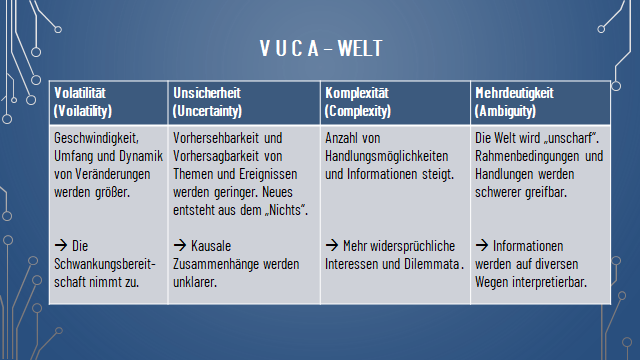
Work takes on a new significance
First of all, we will feel this in our ageing society in the care of relatives, where there has so far been a lack of financial support and other recognition and appreciation. Other aspects such as dealing with climate change, the global economy and the integration of new technologies are added to the list.
What is the problem?
With industrialization in the 19th century, work has become something external: We may choose our profession, but what we actually do in our 40 to 50 years of work is felt to be outside our sphere of influence. We have handed over our lives to an „outside world“, have lived with external constraints and obligations and with a „that's just the way it is!“ attitude.

We knew what we had to do and what the price of wage labor was.
Previously, work was part of the course of life: farmers lived on their farms, they worked to sell their own produce and to be able to feed themselves from what they grew. The carpenter, the joiner, the maid or the innkeeper: work was a part of identity that could not be discarded after the day's work was done.
Digitalization and globalization are now giving us a very confusing world.
Little can be relied on anymore. The coronavirus crisis is showing us this on a massive scale. Unfortunately, our challenges are completely at odds with what people actually need: security. There is certainty when we can build a bridge between cause and effect. When we can understand and comprehend. Targeted coaching can often build this bridge.
Self-responsibility and coaching - when external security seems unstable?

We can shift security to the „inside“ and give our self stability. We can face this uncertainty with unrestricted self-responsibility. Ultimately, it's about being „grown up“ and relating appropriately to the here and now in our thoughts, feelings and behavior. Various methods can be used in coaching to support this process. One of these can be transactional analysis (TA).
TA describes this „being an adult“ as developing an awareness of the old, usually unconscious coping strategies from childhood that guide us and cause us to fall back into old patterns of behavior in stressful and difficult situations (Stewart & Joines, 1990).
The question to ask yourself then is:
„Was my behavior or was my thinking and feeling appropriate for an adult who is responding to what is happening around them at that moment?“
Stewart & Joines, 1990, p.38
Self-responsibility and coaching - the four aspects of self-responsibility
- Self-awarenessThe first step is to know yourself well, to develop an awareness of and about yourself. It's about being a „whole person“ in the office too. Recognizing your feelings and taking them seriously, reflecting on and being able to assess your motivation, your patterns and your actions. In other words, knowing who I actually am. And, based on this, to know what I want and don't want.
- Self-expressionAs we are not alone in this world, it is important to be able to express our own needs and wishes. To be clear and understandable in your own communication. To be able to defend the decisions you make. To act consistently and coherently.
- Self-developmentLifelong learning, primarily in the form of experience-based learning, trial and error and further development, will be essential in the future of work. This also means recognizing and deciding for yourself what and how you should and want to learn. And it means
Self-learning competence and critical Thinking as two of the essential Future skills to recognize.
- Self-managementAnd ultimately, resilience is important. It's about taking your own well-being seriously in order to develop a good use of resources and time. To feel and know what is good for us and to create a balance if necessary.
In coaching, these issues can be worked through step by step, individually and professionally. Each individual aspect is its own coaching universe, so it is possible to dive deep with the right coach and massively optimize the process of self-responsibility.
Self-responsibility is not selfishness
It sometimes happens that a coachee feels that he or she is being selfish when taking on personal responsibility.
By implication, however, self-responsibility does not mean selfishness and isolation. The word already contains part of the meaning - namely giving yourself an answer. However, self-responsibility does not only mean being able to give yourself answers.

It also means that I give these answers in relation to my context for my immediate life. It is also always about my social responsibility. According to Claude Steiner (1997), the highest level of our „emotional awareness“ is „interactivity“, the understanding of the interactions between the feelings of different people.
It's about shaping your own circle of influence. However, we can only have good relationships if we ourselves are stable. If we are clear with ourselves, we can also be clear with other people and engage in good discourse. Self-responsibility provides orientation - also for others. As already mentioned, this world is becoming no less complex and unpredictable; perhaps for some, the „future of work“ is almost unimaginable, like working with AI bots, robots and drones.
But if we all follow the principle of personal responsibility - with or without professional coaching - we can live together in solidarity and responsibly as a community and shape our desirable future together. We hope we have been able to give you an insight into the topic of self-responsibility and coaching. If you have any further questions, please do not hesitate to contact us!
Would you like to benefit from the use of coaching in your company?
Arrange a free initial consultation now! Our experts will be happy to advise you.
Find out more about our coaching services: Business Coaching, Executive Coaching and Management coaching in Frankfurt and throughout Germany.
About the author
Frequently asked questions
Conclusion
Self-responsibility and coaching is not a topic that can be reduced to a simple formula. The most important findings from this article:
- Professional support makes all the difference: Whether in a business or personal context - an experienced coach measurably accelerates development processes.
- Individual fit counts: There is no one-size-fits-all solution. The right method and the right coach are crucial to success.
- Act now: Knowledge alone changes nothing. The first step is always the most important - and often the most difficult.
If you are ready to take the next step, we are at your side as experienced sparring partners. A non-binding initial consultation will clarify whether and how we can support you.
Practical tips: How to get the most out of your coaching
The success of a coaching process depends largely on your own willingness and preparation. Before you start coaching, you should take the time to clearly formulate your goals. What exactly do you want to change? What specific results do you expect? The more precise your objectives, the more focused the coaching process can be.
Between the individual sessions, it is important to actively integrate the insights you have gained into your everyday life. Keep a coaching diary in which you record your progress, challenges and "aha" moments. This reflection reinforces the transfer effect and makes your personal development visible. Many of our clients report that the time between sessions is crucial for lasting change.
Be open to new perspectives and be prepared to question habitual thought patterns. A good coach will challenge you without overwhelming you. Trust the process, even if individual steps seem unfamiliar at first. The best results are achieved when you get involved in the collaboration and play an active role in shaping it. Our experience at Ihr Coaching Institut in Frankfurt has shown that clients who have this basic attitude achieve their goals much faster and more sustainably.
Read also: Coaching costs & fee, Attitude in coaching, Coaching offers
What does self-responsibility and coaching cost?
Costs vary depending on the scope and objectives. An initial consultation at Ihr Coaching Institut is free and without obligation. During this consultation, we will discuss the framework and the most suitable coaching format for your situation.
Why is Where is the problem? important?
"Where is the problem?" plays a central role in the context of self-responsibility and coaching. Our experience from over 20 years of coaching practice shows that this aspect significantly contributes to the success of the entire development process.
Who is self-responsibility and coaching suitable for?
Our self-responsibility and coaching programs are designed for professionals and managers who want to proactively advance their professional and personal development. The 35 certified coaches at the Ihr Coaching Institut offer expertise for a wide range of needs.
How long does a typical coaching process take?
A typical coaching process comprises 8-12 sessions over a period of 3-6 months. The exact duration depends on the individual goals and progress. Initial results can often be seen after 2-3 sessions.
How can I recognize a reputable coach?
Look for recognized certifications (ICF, DBVC, DCV), sound training, demonstrable professional experience and transparent methods. A reputable coach offers a non-binding initial consultation and works with clear agreements.
What is the difference between coaching and therapy?
Coaching is future-oriented and focuses on achieving goals and developing potential. Therapy, on the other hand, treats mental illnesses and focuses on the past. Coaching is aimed at healthy people who want to develop further.
Can coaching also take place online?
Yes, online coaching is just as effective as face-to-face coaching. Studies show that the coaching results are comparable regardless of the format. Online coaching also offers flexibility and time savings.
Tim S. Tabrizi is the founder and executive coach of Ihr Coaching Institut (Frankfurt). He is a certified executive coach (ICF, DBVC) with over 20 years of experience. He has 35 coaches throughout Germany. LinkedIn profile | Ihr Coaching Institut on LinkedIn | Author page →
Arrange a free initial consultation
Head office: +49 69 7880 7771
Executive Line: +49 174 1614 254
Book an appointment online