
Selective demarketing is an efficient way of weeding out. Hardly anyone is aware of the presence, significance and impact of unwanted customers. At least they don't talk about it. And yet studies show that almost every company across all sectors is affected. Often even massively affected!
Unwanted customers, so-called deficit customers in the sense of selective demarketing, are on the one hand unprofitable and strategically insignificant customers.
Under selective demarketing we understand the targeted management of demand from non-target markets and loss-making customer relationships, with The aim is to optimize the efficiency and effectiveness of the entire customer base.
As part of the selective demarketing, we focus overall demand more strongly on the value proposition. In doing so, we avert the risks associated with possible customer exclusion (e.g. shitstorms) from the company.
Would you like to benefit from the use of coaching in your company?
Arrange a free initial consultation now! Our experts will be happy to advise you.
Marketing ethical reflection
The fact that selective demarketing can also include, deliberately denying customers a service or even actively excluding them from offers suggests that at any time and for any measure of selective demarketing it must be ensured that neither against applicable law (e.g. prohibition of discrimination) or internal company ethics rules (such as Codes of Conduct), still marketing ethical principles are violated.
Particularly in the implementation phase of the demarketing management process, it is therefore necessary to check whether the respective demarketing measures can be assessed as marketing-ethically reflected and thus legitimized for implementation. To ensure this, we use a specially developed Reflection approach to.
Our, reflecting the marketing ethic, Process approach is based on an iterative, contrasting and comparative study that subjected all case studies of selective demarketing available in practice and discussed in marketing science to a rule-based examination and a cost-benefit analysis.
Demarketing stage-gate approach

The resulting marketing ethics reflection model follows the structure familiar from innovation management Stage gate model. Selective demarketing must therefore runs through several successive test steps (gates) and can only be transferred to the application if successfully passed all test phases (stages) have been made.
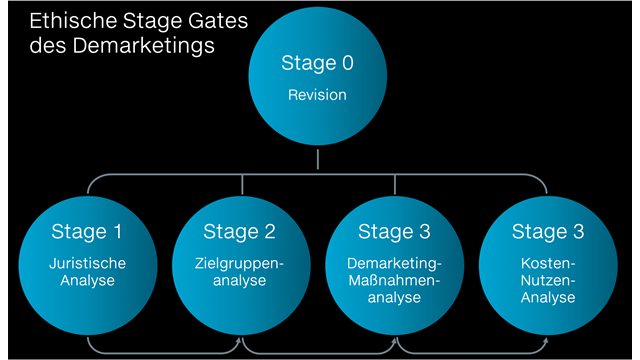
Selective demarketing - stage gates 1 + 2 and 0
The Initial phase includes a Legal qualification, which ensures that the measures under review are not in conflict with applicable law. If there is reasonable suspicion that the selective demarketing constitutes a violation of the law, the next review stage cannot be reached and the measure must be subject to a corresponding revision.
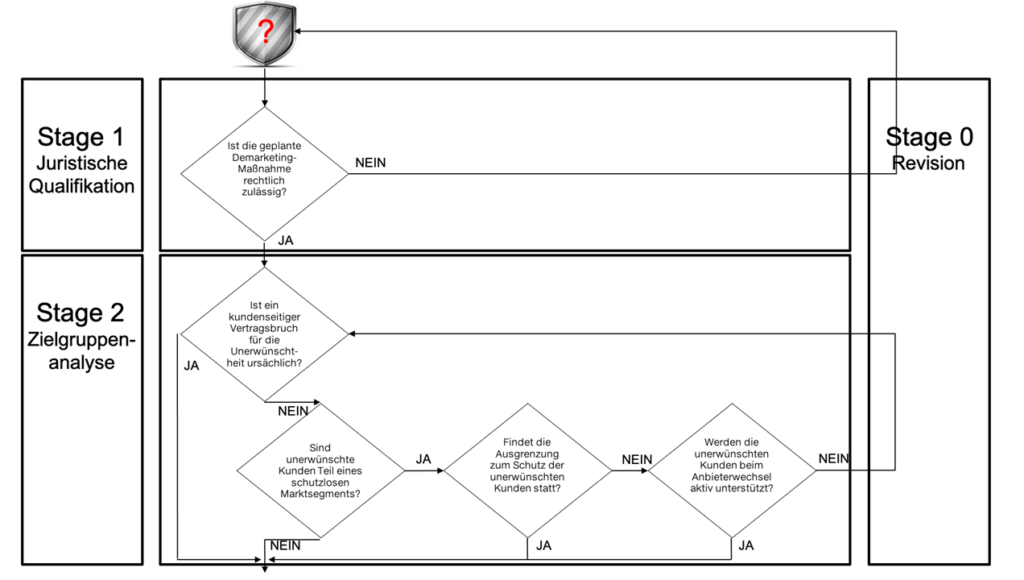
However, if this is not the case, in Phase 2 of the reflection approach a more precise View of those affected by the measure Potentially affected customers thrown up. It must first be clarified whether the undesirability, and therefore the reason for the exclusion, lies in a breach of contract by the customer exists. If this is the case, the third phase can be initiated directly. However, if this is not the case, further investigation is required to determine whether the customers concerned are part of an unprotected market segment are (according to American Marketing Association for example minors or senior citizens).
If the customers addressed by the demarketing measure are part of such a group, the measure can only be transferred to a further review if the exclusion is for their protection or if they are actively helped to switch providers.
Selective demarketing - Stage Gate 3 and 0
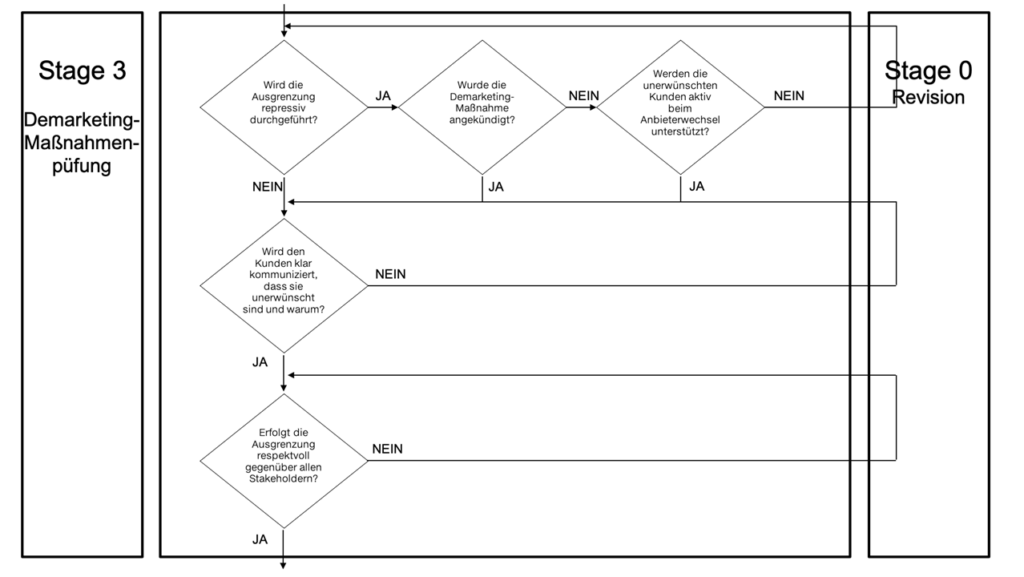
The third and penultimate test then focuses on the actual planned implementation the demarketing measures to be tested. The first question to be answered in this context is the extent to which the measure is repressive. In other words, the question arises as to whether the addressed customers will take possible measures. In principle, a repressive measure can only ever be carried over into a further test phase if the exclusion has been announced or the customers are actively supported in switching providers, as in phase 2.
However, if the exclusion is not repressive, it is only necessary to ensure that all unwanted customers have been informed transparently that they are unwanted from the company's point of view and why. At the same time, respectful treatment of all affected stakeholders must be guaranteed. Selective demarketing is a strategy that does not only affect the company itself.
Selective demarketing - Stage Gate 4 and 0
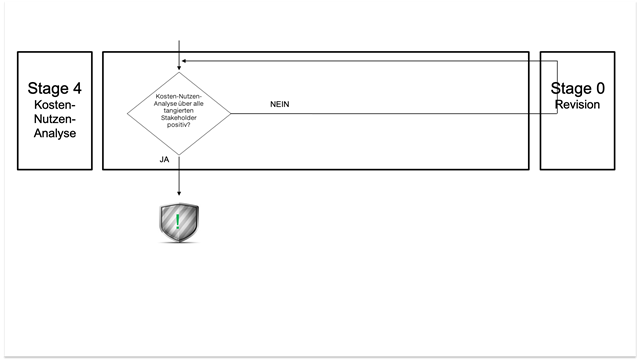
Can the measure subsequently have a positive Cost-benefit balance about these stakeholders, it can be regarded as reflecting marketing ethics and approved for implementation.
Selective demarketing as part of corporate transformation
Selective demarketing is Part of the company transformation. Transformation means Change through critical reflectionto NEW to START, the STATUS QUO to CHANGE and the BUSINESS to EXPAND.
Selective demarketing is a Approach to the transformation of customer orientation - away from the „customer is king“ broadband antiseptic and towards the „the right customer is king“ philosophy.
But selective demarketing is much more than that. It not only focuses attention on the desired customers, it also raises brand awareness, increases the importance of corporate and marketing ethics, focuses on employees (employees first, customers second), puts Resources and creates space for change.
Would you like to benefit from the use of coaching in your company?
Arrange a free initial consultation now! Our experts will be happy to advise you.
Find out more about our coaching services: Business Coaching, Executive Coaching and Management coaching in Frankfurt and throughout Germany.
About the author
Frequently asked questions
Practical tips: How to get the most out of your coaching
The success of a coaching process depends largely on your own willingness and preparation. Before you start coaching, you should take the time to clearly formulate your goals. What exactly do you want to change? What specific results do you expect? The more precise your objectives, the more focused the coaching process can be.
Between the individual sessions, it is important to actively integrate the insights you have gained into your everyday life. Keep a coaching diary in which you record your progress, challenges and "aha" moments. This reflection reinforces the transfer effect and makes your personal development visible. Many of our clients report that the time between sessions is crucial for lasting change.
Be open to new perspectives and be prepared to question habitual thought patterns. A good coach will challenge you without overwhelming you. Trust the process, even if individual steps seem unfamiliar at first. The best results are achieved when you get involved in the collaboration and play an active role in shaping it. Our experience at Ihr Coaching Institut in Frankfurt has shown that clients who have this basic attitude achieve their goals much faster and more sustainably.
Scientific basis and effectiveness
The effectiveness of coaching has been proven by numerous scientific studies. A meta-analysis by the International Coach Federation shows that 80% of coached individuals experience a significant improvement in their self-efficacy. Other studies show positive effects on stress reduction, decision-making quality and interpersonal communication.
Research provides impressive results, particularly in the area of leadership development. A study by the Manchester Consulting Group showed an average return on investment of 5.7 times the coaching budget invested. The improvements were reflected in increased productivity, higher employee satisfaction and improved working relationships.
Neurobiological research explains why coaching is so effective: new neuronal connections are formed in the brain through targeted reflection and new experiences of action. This process, known as neuroplasticity, enables lasting changes in behavior. At Ihr Coaching Institut, we work exclusively with evidence-based methods that put these scientific findings into practice. Our certified coaches combine sound specialist knowledge with many years of practical experience.
Conclusion
Growth through ethical reduction is not a topic that can be reduced to a simple formula. The most important findings from this article:
- Professional support makes all the difference: Whether in a business or personal context - an experienced coach measurably accelerates development processes.
- Individual fit counts: There is no one-size-fits-all solution. The right method and the right coach are crucial to success.
- Act now: Knowledge alone changes nothing. The first step is always the most important - and often the most difficult.
If you are ready to take the next step, we are at your side as experienced sparring partners. A non-binding initial consultation will clarify whether and how we can support you.
The coaching process: procedure and phases
A professional coaching process follows a clear structure that is divided into several phases. In the orientation phase, the coach and client clarify the issue together, define specific goals and agree on the framework for the collaboration. This clarification of the assignment is crucial for later success, as it determines the direction and focus of the entire process.
During the work phase, new perspectives are opened up, resources activated and concrete action strategies developed with the help of various coaching methods. Your coach will ask specific questions to stimulate reflection and support you in developing individual solutions. Between sessions, you put the insights gained into practice and gain new experiences.
The final phase is used for reflection and sustainability assurance. Together, you evaluate the progress you have made, anchor successful strategies and plan the next steps for your further development. At Ihr Coaching Institut, we attach particular importance to careful evaluation so that you can clearly state the benefits of your coaching - both for yourself and for your employer.
Read also: Digital growth, The future of coaching, The psychology behind personal growth
What is meant by growth through ethical reduction?
Growth through ethical reduction describes a targeted development process based on scientifically sound methods. The certified coaches at Ihr Coaching Institut support you in achieving sustainable change.
Why is the demarketing stage-gate approach important?
The demarketing stage-gate approach plays a central role in the context of growth through ethical reduction. Our experience from over 20 years of coaching practice shows that this aspect significantly contributes to the success of the entire development process.
How do I find the right coach for growth through ethical reduction?
Look for recognized certifications (ICF, DBVC), demonstrable experience, and a good personal fit. Ihr Coaching Institut offers a free initial consultation to help you find the right coach from our team of 35 experts.
How long does a typical coaching process take?
A typical coaching process comprises 8-12 sessions over a period of 3-6 months. The exact duration depends on the individual goals and progress. Initial results can often be seen after 2-3 sessions.
How can I recognize a reputable coach?
Look for recognized certifications (ICF, DBVC, DCV), sound training, demonstrable professional experience and transparent methods. A reputable coach offers a non-binding initial consultation and works with clear agreements.
What is the difference between coaching and therapy?
Coaching is future-oriented and focuses on achieving goals and developing potential. Therapy, on the other hand, treats mental illnesses and focuses on the past. Coaching is aimed at healthy people who want to develop further.
Can coaching also take place online?
Yes, online coaching is just as effective as face-to-face coaching. Studies show that the coaching results are comparable regardless of the format. Online coaching also offers flexibility and time savings.
Tim S. Tabrizi is the founder and executive coach of Ihr Coaching Institut (Frankfurt). He is a certified executive coach (ICF, DBVC) with over 20 years of experience. He has 35 coaches throughout Germany. LinkedIn profile | Ihr Coaching Institut on LinkedIn | Author page →
Arrange a free initial consultation
Head office: +49 69 7880 7771
Executive Line: +49 174 1614 254
Book an appointment online